Stop Skipping the Math Modeling Tasks. AI Makes Them More Important.

Stop Skipping the Math Modeling Tasks. AI Makes Them More Important.

We’ve all been there. You’re running out of time in a unit, and you have to decide what to cut.

And what gets cut? The modeling tasks.

You know the ones. They take longer than you think they will. Students aren’t always sure where to start. There might be a lot of different approaches, and sometimes there isn’t even one right answer.

So we skip them. At least I did. 

But with AI changing what students can do (and what they can get AI to do for them), I’m starting to think those are exactly the tasks we should be making more time for.

Think about what AI can already do.

Solve equations? Yep.

Graph functions? Yes. Sometimes.

Work through a word problem and explain each step? Usually pretty well.

Of course, students still need to understand the math. I’m not suggesting we throw out procedural fluency or stop teaching students how to solve equations.

But if AI can already do so much of what we’re asking students to do in math class, shouldn’t we be thinking about what we’re spending our time on?

This is where modeling comes in.

Let’s say you take modeling prompt 3 from Illustrative Math Grade 9: 

The average adult needs 2,000 calories a day. What’s the best way to achieve that goal?

Before anyone starts calculating, there are decisions to make.

What makes an ‘average’ adult? How do you define ‘best’? Are we looking for least expensive? Most expensive? Most convenient? Most delicious? 

Students have to figure out what they need to know, make some assumptions, and then “do the math.”

And I put ” do the math” in quotes deliberately, because I think that’s how a lot of students see it. All that questioning, estimating, and making assumptions? That’s just the stuff you do before “the math” starts. Students think “math” = “calculate”

But that’s not true! All of it is doing math. Asking questions, deciding what matters, making assumptions, building a model, calculating, and checking whether your answer makes sense. That’s all mathematical thinking, and we need students to see it that way. More modeling tasks can help us with this culture change. 

Different groups will come up with different answers. Now we have something to talk about! Why did one group choose to eat only ramen? While another chose organic and free range eggs? Why did one group shop only at grocery stores while another purchased only fast food? 

Which assumptions made the difference? Does either answer seem more reasonable?

There’s a lot of math happening here, and very little of it is in the calculations.

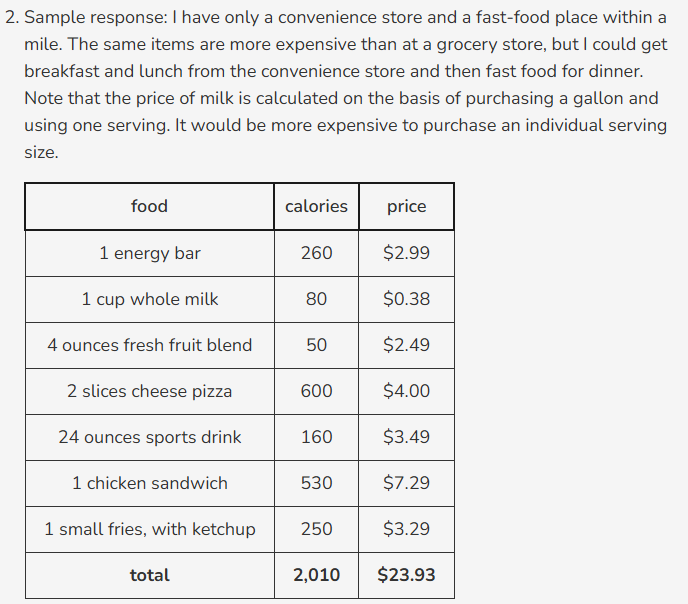
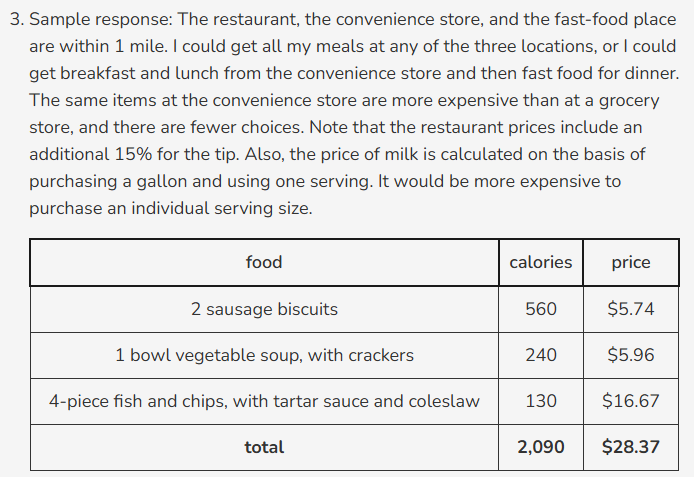
Check out these Sample Student Responses:
 

But wait. Can’t AI do modeling tasks, too?

Yep. It absolutely can.

AI can make assumptions, estimate quantities, and work through these problems. It might even come up with a pretty good answer.

But that’s actually part of why I think modeling is so important.

If a student asks AI the best way to get 2000 calories it says ‘for balanced nutrition aim for 25% protein, 45% carbohydrates, and 30% fats.’ What happens next?

Do they just accept that answer? Or do they ask where those numbers came from? What assumptions did AI make? Does that answer make sense for their context?

I want students to be able to have that conversation. To question an answer, defend their own thinking, and recognize when something doesn’t quite add up.

And the only way they get better at that is by having opportunities to do it.

So maybe we rethink what gets cut.

I’m not saying every lesson needs to be a big, open-ended modeling investigation. We all know there are only so many minutes in a school day.

But maybe, instead of skipping the modeling task, we prioritize one this school year.

Give students a problem where they have to make some decisions. Let them wrestle with what information they need. Have them compare their approaches, question their assumptions, and revise their thinking.

Because as AI gets better at doing the calculations, I think it’s becoming even more important that our students understand the decisions behind them.


Want to go deeper? Email me at karen@mathforhumans.ai for access to my Use AI to Differentiate Learning: 19 Prompts That Work. This resource moves beyond basic leveling to support authentic mathematical reasoning for every learner. 

For ongoing strategies on math and AI, connect with me on LinkedIn.

The future of math education isn’t about AI replacing expertise. It’s about AI amplifying your ability to meet every student where they are while challenging them to think deeply about mathematics.


Check out the modeling task and Sample Student Responses on IM’s website, Integrated Math 1, Modeling Prompt 3: 2,000 Calories
25.08.28 Deeper Into Differentiation 2000x1333

Deeper Into Differentiation: How AI Can Help Us Reach All Learners in Math

Guest post on Tom Daccord’s Substack

Every Sunday as a classroom teacher, I faced the same overwhelming truth: my 28 students had 28 different learning needs. I understood differentiation – choice, scaffolds, low floor/high ceiling tasks – but the hours required to implement it daily simply didn’t exist. I knew my students deserved more, but I couldn’t outwork the clock.

If this sounds like the math teachers in your building, you’re not alone. And there’s finally a solution. 

AI tools can transform the weekend burden into manageable weekday tasks. 

As Tom noted in his post on scaffolding, this potential here is real. Below I’ll show practical AI differentiation strategies that meet diverse student needs without sacrificing teacher weekends.

How to Write Effective Prompts

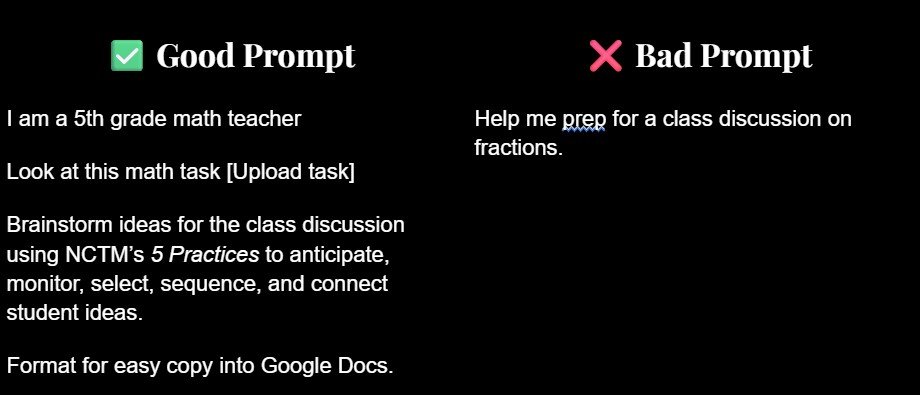
A strong prompt for math differentiation has four parts:

  • Persona – Who you are (e.g., “I am a 5th grade math teacher”).
  • Aim – What you want AI to do (e.g., brainstorm, adapt, generate problems).
  • Math Research Frame – The strategy you want it to use (e.g., NCTM’s Principles to Actions, Universal Design for Learning, WIDA Level, etc.).
  • Format/Structure – How you want the output organized (e.g., table, bullet points, copy-paste ready).

Here is a good and bad example.

Why Research-Based Prompts Get Better Results

Large language models like ChatGPT are trained on general internet data, so they “know” contradictory things about math teaching. They know good pedagogy involves real contexts, visual representations, and conceptual understanding. But they also know that most math instruction defaults to memorized procedures, tricks, and “just do it this way” explanations.

Without guidance, AI defaults to lower standards and harmful shortcuts.

Strong differentiation prompts solve this by grounding requests in research-based practices. This article uses National Council of Teacher of Mathematics (NCTM) differentiation guidance to direct AI toward proven pedagogy.

NCTM offers over ten differentiation recommendations. Below are three strategies that demonstrate what’s possible when AI meets research-based practice. Take what resonates and use AI to differentiate based on the principles that work best for your students and context.

Strategy 1: Use Open Tasks for Multiple Entry Points

Traditional differentiation often means creating easy and harder versions of problems. While this can be effective, open tasks, inspired by Marian Small and Open Middle, meet the needs of varied students, allow for multiple entry points and spark rich classroom conversations. Let’s see it in action.

*Note: In this article, I’ll use ChatGPT in the examples, but you can substitute your AI of choice (Gemini, Claude, Khanmigo, etc.).

Prompt: 

Create an open math problem about fractions that 4th graders can approach at different levels. The problem should have multiple solution strategies and allow for both basic and advanced thinking. Use Marian Small’s theory of differentiating instruction. 

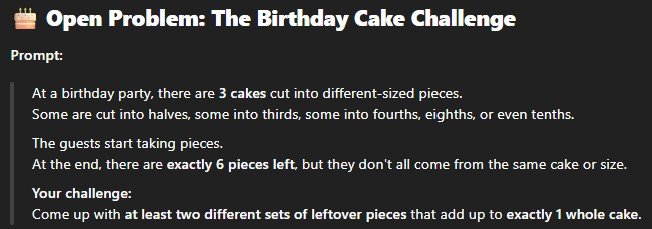
What ChatGPT Gives:

🎯 Differentiation Technique: Open-ended question with multiple entry points – students can use simple fractions or challenge themselves with complex ones.

⚠️ What Happens Without the Research Framework: Try the same prompt but remove “Use Marian Small’s theory of differentiating instruction.”

What you get instead: A closed, step-by-step problem that claims to be differentiated because students “can use pictures or manipulatives.” This misses the point entirely.

✅ Why it works: Including research frameworks in prompts produces significantly better results than generic requests. Generic prompts yield traditional worksheet problems disguised as differentiation.

Strategy 2: Adapt Language Without Lowering the Math

In many classrooms, students bring different home languages and a varying levels of English proficiency. Adjusting instructions for each can be time-consuming, but the goal is always the same: make the language accessible while keeping the mathematics intact.

Prompt: Reword this math instruction for a multilingual learner at WIDA Level 2: [insert instructions]

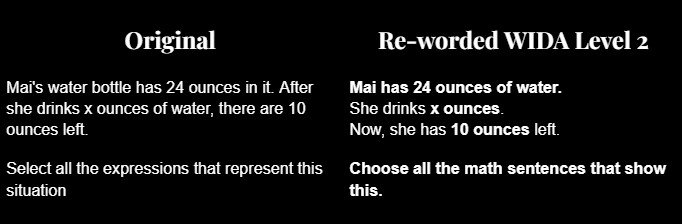
What ChatGPT Gives: 

🎯 Differentiation Technique: Shorter sentences, simpler vocabulary, clearer structure.

✅ Why it works: AI excels at language modifications and translations. However, watch for removed vocabulary words and prompt AI to include them.

Strategy 3: Connect Math to Student Interests

Choice gives students autonomy, boosting motivation and engagement. AI makes it easy to adapt the same math concept into contexts that match different student interests.

Prompt: “I’m teaching about graphing linear equations to 8th graders. Three students love sports. Create word problems that connect to this interest.”

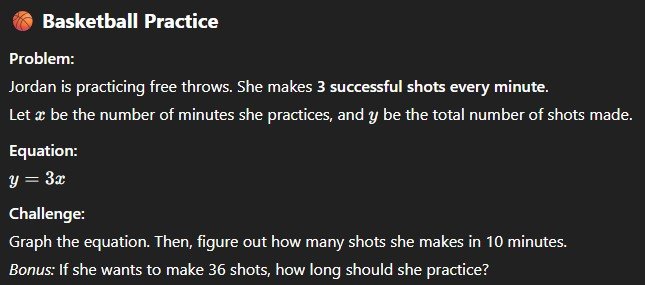
What ChatGPT Gives:

🔄 Follow up: 

  • Give me problems for students who love cooking
  • Create versions for students interested in social media

⚠️ Caution: ChatGPT can make up problems that don’t make sense. Always complete the problems before giving them to students.

✅ Why it works: When learners engage with a topic they care about, or feel ownership over how they approach a task, whether choosing the challenge level, strategy, tool, or mode of expression, they are more likely to persist and invest effort.

These three approaches show how AI can support differentiation needs. 

But AI has limits.

When AI Misses the Mark

While AI works well for these three strategies, AI isn’t a magic solution for every teaching challenge. 

I tried multiple times to create a graphic organizer for comparing linear equations, but every version stripped the thinking from the task. Not every task benefits from AI. Use your judgment to refine or abandon. 

Next Level: Custom AI for Differentiation

When standard prompts reach their limits, that’s where specialized AI tools become essential. Specialized AI tools like Custom GPTs (ChatGPT Plus) and Gemini Gems (free through Google for Education) trained specifically for math differentiation are transformative. I’ve developed custom AI that understands both differentiation principles and mathematical pedagogy, trained on research about productive struggle and maintaining cognitive demand. 

The difference is striking. Standard AI defaults to lower expectations and teaching tricks. Custom AI maintains rigor, focuses on conceptual understanding, and adjusts support. 

Student-facing AI tools are emerging too, but those raise different questions and aren’t the focus here.

For leaders implementing at scale, this eliminates the trial and error cycle that burns out teachers and ensures consistent, research-aligned results across your math team.

A 3-Step Framework for Leaders

Teachers can use these strategies tomorrow. But for leaders, individual experiments aren’t enough. Moving from experimentation to purposeful use requires a clear framework, one that turns AI overwhelm into strategic clarity.

Step 1: Start Small

  • Choose one challenging unit
  • Try one strategy from above
  • Test with a pilot group

Step 2: Evaluate 

  • Does this maintain productive struggle?
  • Are all students engaging in mathematical reasoning?
  • Are we supporting thinking or replacing it?

Step 3: Scale Strategically 

  • Focus: Use AI where it amplifies expertise and solves a specific problem
  • Define Success: Work with your team to agree on what “good use” looks like for teachers, students, staff
  • Grow What Works: Expand strategies that show impact. Drop or adjust what doesn’t.

The Bottom Line: Guidance Makes the Difference

Without clear guidance, AI creates noise and risks removing the thinking from students. With the right guidance, it saves teachers time and deepens student reasoning.

Ready to Transform Your Math Differentiation?

The strategies shared are just the beginning. Don’t let another year go by with AI creating mediocre worksheets. Equip your team with strategies that honor both student complexity and mathematical beauty.

Want to go deeper? Email me at karen.levin.education@gmail.com for access to my Use AI to Differentiate Learning: 19 Prompts That Work. This resource moves beyond basic leveling to support authentic mathematical reasoning for every learner. 

For ongoing strategies on math and AI, connect with me on LinkedIn.

The future of math education isn’t about AI replacing expertise. It’s about AI amplifying your ability to meet every student where they are while challenging them to think deeply about mathematics.

25.07.09 Blog Header How to Differentiate Math Instruction Using ChatGPT 2000x1333

How to Differentiate Math Instruction Using ChatGPT

Every Sunday, I faced the same overwhelming truth: my 28 students had 28 different learning needs. I understood differentiation – choice, open problems, low floor/high ceiling tasks – but the hours required to implement it daily simply didn’t exist. I was trapped in a guilt cycle, knowing my students deserved more but constantly losing to the clock. Does this crushing weight sound familiar?

AI Solution: Faster Differentiation

Here’s what’s changed: AI tools like ChatGPT can transform the time-intensive work of differentiation into manageable tasks. What used to take hours can now happen in minutes.

ChatGPT can help you:

  • Add choice and challenge to any math problem
  • Level math text for multilingual learners in seconds
  • Brainstorm strengths-based strategies for specific students
  • Adjust lessons based on your students’ interests and backgrounds

The best part? You’re not abandoning your expertise or cutting corners. You’re amplifying what you already know works, but doing it faster and more efficiently.

Research-Based Framework

This isn’t about replacing proven methods with flashy technology. Instead, we’re using AI to implement research-based practices more effectively. The prompt ideas are based on the National Council of Teachers of Mathematics (NCTM) differentiated learning in math and Marian Small’s work on differentiating math instruction through open and parallel problems.

ChatGPT excels at helping us create these types of problems quickly, while ensuring they align with proven differentiation principles.

Practical AI Prompts That Work

Here are three prompts you can try today. Need a ChatGPT account? Sign up free at chat.openai.com.

AI Best Practices

  • Never include student names, specific personal details, or sensitive information in prompts. 
  • Use general descriptions like “a student struggling with fractions” rather than identifying information.
  • Limitations: Always double-check accuracy. AI doesn’t know your students or classroom culture. Use it as a starting point, not the final answer.
  • Best for: Quick content generation, brainstorming, text adaptation, creating variety

Prompt 1: Choice and Challenge

Your Prompt: Create an open math problem about fractions that 4th graders can approach at different levels. The problem should have multiple solution strategies and allow for both basic and advanced thinking. Use Marian Small’s theory of differentiating instruction. 

What ChatGPT Gives You:

✅ Why it works: Open-ended question with multiple entry points – students can use simple fractions or challenge themselves with complex ones.

Prompt 2: Language Needs

Your Prompt: Reword this math instruction for a multilingual learner at WIDA Level 2: [insert instructions]

What ChatGPT Gives You: A reworded version for a multilingual learner at WIDA Level 2

✅ Why it works: Shorter sentences, simpler vocabulary, clearer structure.

Prompt 3: Adapting Lessons for Student Interests

Your Prompt: “I’m teaching about graphing linear equations to 8th graders. Three students love sports. Create word problems that connect to this interest.”

What ChatGPT Gives You: Problems about basketball shot percentages, soccer scoring, etc. Same math skills, but tied to student interests.

✅ Follow up: “Give me problems for students who love cooking” or “…who love social media.”

⚠️ Caution: ChatGPT can make up problems that don’t make sense. Always complete the problems before giving them to students.

Prompt FAIL: Graphic Organizer

Your Prompt: “I have this math problem: Create a graph showing the equations y=1/3x  and  y=1/3x-4. Explain how the graphs are the same and how they are different. 

My students need more scaffolding to be successful. Create a graphic organizer.”

What ChatGPT Gives You: A basic organizer that removes too much thinking from the activity.

My follow-up attempts yielded similar results: ‘Give me a better graphic organizer that doesn’t remove the thinking…’ Even after trying again, it wasn’t usable.

At this point I gave up on ChatGPT for this specific prompt. Remember, ChatGPT is not a math teaching tool, so you’ll need to use your teacher judgment often. It is excellent at brainstorming so don’t throw it all away when you get a failed response! These mixed results highlight exactly why AI works best as a collaborative tool—you bring the teaching expertise to guide and refine what it generates.

Conclusion and Next Steps

Differentiation doesn’t have to be an all-or-nothing proposition anymore. You don’t have to choose between serving all your students well and maintaining your sanity.

Try it Out: Start this summer

  • Pick one lesson you wanted to differentiate but didn’t have time
  • Try one prompt above
  • Note where it could help next year

AI enhances your expertise – it doesn’t replace it. You still bring the relationships, assessment, and deep math knowledge. ChatGPT just makes it faster.

Your students deserve differentiated instruction. You deserve time for your life. With AI, you can have both.

Ready to try more? Email me at karen@mathforhumans.ai for a free PDF: 19 AI Prompts for Math Differentiation.

25.07.03 Blog Header AI for Math Teachers Where to Start and What to Avoid 2000x1333

AI for Math Teachers: Where to Start and What to Avoid

There’s a lot of talk about AI in math education. Is it revolutionary? The beginning of the end of students thinking? Like most things in teaching, the truth is somewhere in the middle.

If you’re a math teacher feeling stretched thin, drowning in differentiation, or just plain curious about how this AI thing could actually help you in math teaching, here’s what you need to know:

You don’t need to master AI. You just need to start by playing.

Just Play

The best way to learn AI is the same way we learn anything new: start small, be curious, and play. Open up a tool like ChatGPT, Claude, or Gemini. Think of it as a super-powered assistant that’s ready to brainstorm with you. 

Try asking it to:

  • Write three exit tickets on adding fractions for students at different readiness levels
  • Reword this math instruction for a multilingual learner at WIDA level 2: [insert instructions]
  • Explain the concept of standard deviation in a way that connects to sports statistics

You don’t need a clear goal or a polished lesson plan. Just mess around. See what it does… and doesn’t do.

Why It Matters

AI is already really good at solving problems. The “back of the book” is now available 24/7.

This doesn’t replace us; it elevates us. It means what matters most is what’s not in the back of the book: Reasoning. Strategy. Modeling. Discussion. Reflection. These are the higher-order thinking skills that AI can’t replicate.

So no, AI doesn’t replace us. It puts even more value on what only teachers can do: Help students make sense of math and own their thinking. It frees us up to focus on the deeply human aspects of teaching and learning.

What to Avoid

  • Don’t ask it to write your whole lesson plan. It’s just not there yet and it doesn’t know your students.
  • Always check its work. AI can be wildly confident and totally wrong. Your teacher judgment is crucial.
  • Don’t just put students on ChatGPT and assume they will know how to use it. If you’re curious about student-friendly math AI tools, stay tuned – I’ll be posting those soon. 
  • Keep student data safe. Never put student names or identifying info into an AI tool.
  • Don’t try to do everything at once. Start small. Start safe. Start simple.

What’s Next?

As you start to play, you’ll likely discover some unexpected uses (and limitations!). This initial exploration is key to understanding how more specialized tools work.

In the next post, I’ll dive into math-specific AI tools like Khanmigo, Coteach.ai, Snorkl, Edia, and others, breaking down how they differ from generic AI and how they can specifically enhance your math classroom.

  • 🧠 As you start to play, what unexpected things did you discover? Share your ‘aha!’ moments or even your ‘huh?’ moments in the comments!
  • 📩 Reply to this post or DM me, and I’ll send you a free prompt library you can start using tomorrow.

You don’t need to do this alone. Let’s figure it out together.

Blog Header Making AI Work for Your Math Team

Making AI Work for Your Math Team: A Guide for Leaders

Three teachers approach you in one week asking about AI policy. One wants to ban it, one wants to require it, and one just wants to know if using ChatGPT to write parent emails will get them fired.

For school or district leaders, the pressure to “do something about AI” can be intense. But here’s the truth: clarity beats urgency.

You don’t need to jump into the deep end, you need to start with the right questions.

Start by Solving for “Why”

Before bringing any tool into a math classroom, ask: What problem are we trying to solve with AI?

Are you trying to:

  • Lighten teacher workload? Imagine AI auto-generating differentiated practice problems or drafting parent communication.
  • Offer students better, more personalized feedback? Think about AI helping students understand why they made a mistake, not just what the mistake was.
  • Make differentiation more manageable? AI can help teachers quickly tailor assignments to individual student needs without hours of prep.
  • Encourage more open-ended questions and deeper reasoning? AI can support teachers in crafting richer tasks that move beyond rote memorization.
  • Provide personalized coaching to math teachers? AI can offer instant transcripts of classrooms and a breakdown of student talk versus teacher talk.
  • Reduce over-reliance on shortcuts like Photomath and MathGPT? AI can shift student thinking from “find the answer” to “understand the process and verify.”

“We should be using AI” is not a strategy.

“We want to give teachers tools that help them plan and differentiate faster” that’s a strategy.

Sum Up Current Efforts

You may not be starting from scratch. Ask:

  • Who are your early adopters? A few teachers may already be using AI to brainstorm differentiation ideas or connect math to student interests.
  • What’s the current math EdTech culture? Positive? Burned out? Overloaded with tools?
  • What are your math teachers working on instructionally? If the focus is on reasoning or problem solving, AI might help, but not if it becomes a distraction.
  • What are your students doing? Is MathGPT or Photomath being used in ways that concern teachers? Are students using AI for shortcuts, or for support?
  • Do you have a school- or district-wide policy for AI use? If not, building in time for discussions is a crucial first step for consistency and clarity.

Tools to Guide Your Next Steps

Here are some tools for leading thoughtful discussions about AI with your math team:

Guidance and Planning Resources

  1. NCTM Position on Artificial Intelligence: This position offers a strong argument for avoiding ‘shallow’ assessments and using AI to shift students’ thinking from solving alone to a mix of solving and verifying.
  2. Leon Furze’s AI Assessment Use Scale: This rubric-style tool helps students self-report how they used AI on an assignment. It’s a fantastic entry point for team discussions around integrity, transparency, and policy. Stay tuned for an AI Assessment Use Scale specifically adapted for math.
  3. Common Sense AI Toolkit for Districts: This toolkit offers reflection questions, conversation guides, and planning tools to help leaders implement AI in ways that are aligned, ethical, and sustainable. It also provides guidance on the crucial topic of data privacy.

Math Specific Tools to Explore

  1. Coteach.ai: Built specifically for teachers using Illustrative Mathematics, this tool offers lesson planning and in-lesson suggestions aligned to the curriculum. Even if you use a different curriculum, it’s built for math teachers so worth playing with it.
  2. Khanmigo: (Teacher Dashboard) A free AI assistant for teachers: brainstorm real-world math contexts, write parent emails, even review a concept before teaching.
  3. Snorkl: (Student Feedback Tool) Students show their work by writing or speaking, and the AI offers feedback on their reasoning. Still in early stages, but worth exploring if you’re interested in formative feedback at scale.
  4. Edia: (Teacher and Student Tool) Teachers can assign both pre-made and custom-created questions. The platform is aligned with Common Core and state standards, integrates with curricula, and includes an AI tutor and anti-cheating tools.

What to Avoid

  • ❌ Don’t rush into new tools without clear goals.
  • ❌ Don’t make AI mandatory before building staff trust and buy-in.
  • ❌ Don’t treat AI as separate from your curriculum and instructional priorities.
  • ❌ Don’t ignore the digital divide. Ensure equitable access to tech for all students.
  • ❌ Don’t treat AI as a replacement for teaching. Ultimately, teaching is about relationships.

Where to Go From Here

Start small. Keep it grounded. Make sure AI conversations are tied to the real work your math teams are already doing.

And don’t go it alone.

For example, pick one willing teacher to pilot one AI use case or tool this summer. Have them share their experience, both the wins and failures, at the beginning of school year PD.

Share what you’re wondering about with math and AI in the comments below. What have I gotten wrong, or what am I missing? Let’s learn and grow together.

You don’t need a perfect AI plan.

You need a thoughtful one that fits your team.