

We’ve all been there. You’re running out of time in a unit, and you have to decide what to cut.
And what gets cut? The modeling tasks.
You know the ones. They take longer than you think they will. Students aren’t always sure where to start. There might be a lot of different approaches, and sometimes there isn’t even one right answer.
So we skip them. At least I did.
But with AI changing what students can do (and what they can get AI to do for them), I’m starting to think those are exactly the tasks we should be making more time for.
Think about what AI can already do.
Solve equations? Yep.
Graph functions? Yes. Sometimes.
Work through a word problem and explain each step? Usually pretty well.
Of course, students still need to understand the math. I’m not suggesting we throw out procedural fluency or stop teaching students how to solve equations.
But if AI can already do so much of what we’re asking students to do in math class, shouldn’t we be thinking about what we’re spending our time on?
This is where modeling comes in.
Let’s say you take modeling prompt 3 from Illustrative Math Grade 9:
The average adult needs 2,000 calories a day. What’s the best way to achieve that goal?
Before anyone starts calculating, there are decisions to make.
What makes an ‘average’ adult? How do you define ‘best’? Are we looking for least expensive? Most expensive? Most convenient? Most delicious?
Students have to figure out what they need to know, make some assumptions, and then “do the math.”
And I put ” do the math” in quotes deliberately, because I think that’s how a lot of students see it. All that questioning, estimating, and making assumptions? That’s just the stuff you do before “the math” starts. Students think “math” = “calculate”
But that’s not true! All of it is doing math. Asking questions, deciding what matters, making assumptions, building a model, calculating, and checking whether your answer makes sense. That’s all mathematical thinking, and we need students to see it that way. More modeling tasks can help us with this culture change.
Different groups will come up with different answers. Now we have something to talk about! Why did one group choose to eat only ramen? While another chose organic and free range eggs? Why did one group shop only at grocery stores while another purchased only fast food?
Which assumptions made the difference? Does either answer seem more reasonable?
There’s a lot of math happening here, and very little of it is in the calculations.
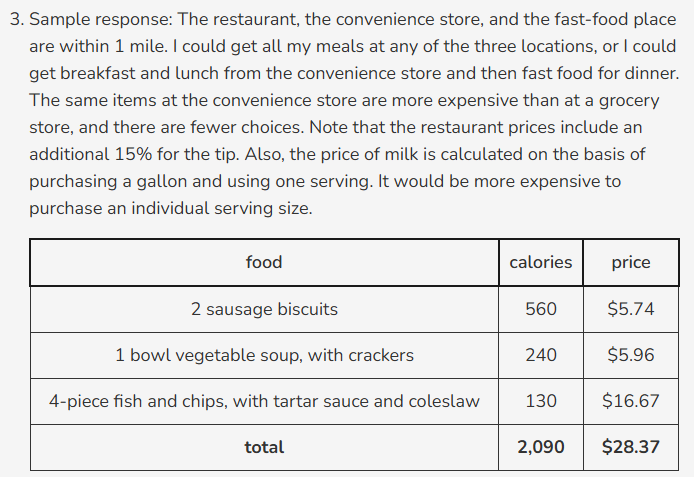
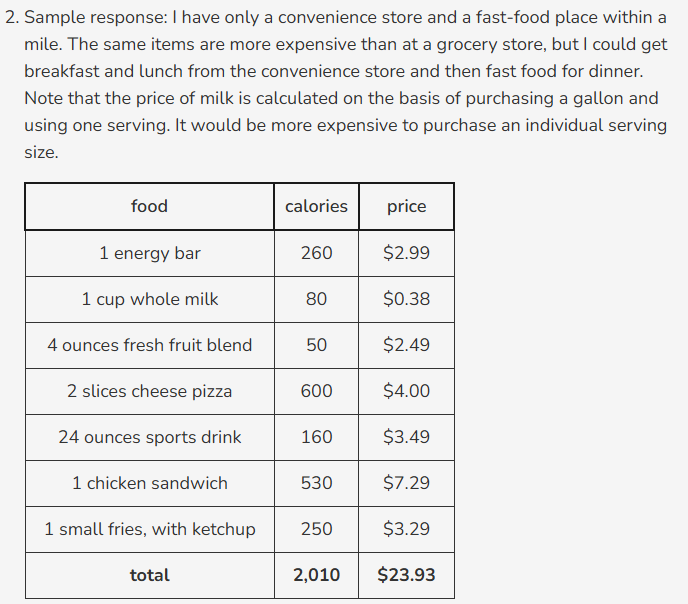
Check out these Sample Student Responses:
But wait. Can’t AI do modeling tasks, too?
Yep. It absolutely can.
AI can make assumptions, estimate quantities, and work through these problems. It might even come up with a pretty good answer.
But that’s actually part of why I think modeling is so important.
If a student asks AI the best way to get 2000 calories it says ‘for balanced nutrition aim for 25% protein, 45% carbohydrates, and 30% fats.’ What happens next?
Do they just accept that answer? Or do they ask where those numbers came from? What assumptions did AI make? Does that answer make sense for their context?
I want students to be able to have that conversation. To question an answer, defend their own thinking, and recognize when something doesn’t quite add up.
And the only way they get better at that is by having opportunities to do it.
So maybe we rethink what gets cut.
I’m not saying every lesson needs to be a big, open-ended modeling investigation. We all know there are only so many minutes in a school day.
But maybe, instead of skipping the modeling task, we prioritize one this school year.
Give students a problem where they have to make some decisions. Let them wrestle with what information they need. Have them compare their approaches, question their assumptions, and revise their thinking.
Because as AI gets better at doing the calculations, I think it’s becoming even more important that our students understand the decisions behind them.
Want to go deeper? Email me at karen@mathforhumans.ai for access to my Use AI to Differentiate Learning: 19 Prompts That Work. This resource moves beyond basic leveling to support authentic mathematical reasoning for every learner.
For ongoing strategies on math and AI, connect with me on LinkedIn.
The future of math education isn’t about AI replacing expertise. It’s about AI amplifying your ability to meet every student where they are while challenging them to think deeply about mathematics.
Check out the modeling task and Sample Student Responses on IM’s website, Integrated Math 1, Modeling Prompt 3: 2,000 Calories