


Every Sunday, I faced the same overwhelming truth: my 28 students had 28 different learning needs. I understood differentiation – choice, open problems, low floor/high ceiling tasks – but the hours required to implement it daily simply didn’t exist. I was trapped in a guilt cycle, knowing my students deserved more but constantly losing to the clock. Does this crushing weight sound familiar?
AI Solution: Faster Differentiation
Here’s what’s changed: AI tools like ChatGPT can transform the time-intensive work of differentiation into manageable tasks. What used to take hours can now happen in minutes.
ChatGPT can help you:
- Add choice and challenge to any math problem
- Level math text for multilingual learners in seconds
- Brainstorm strengths-based strategies for specific students
- Adjust lessons based on your students’ interests and backgrounds
The best part? You’re not abandoning your expertise or cutting corners. You’re amplifying what you already know works, but doing it faster and more efficiently.
Research-Based Framework
This isn’t about replacing proven methods with flashy technology. Instead, we’re using AI to implement research-based practices more effectively. The prompt ideas are based on the National Council of Teachers of Mathematics (NCTM) differentiated learning in math and Marian Small’s work on differentiating math instruction through open and parallel problems.
ChatGPT excels at helping us create these types of problems quickly, while ensuring they align with proven differentiation principles.
Practical AI Prompts That Work
Here are three prompts you can try today. Need a ChatGPT account? Sign up free at chat.openai.com.
AI Best Practices
- Never include student names, specific personal details, or sensitive information in prompts.
- Use general descriptions like “a student struggling with fractions” rather than identifying information.
- Limitations: Always double-check accuracy. AI doesn’t know your students or classroom culture. Use it as a starting point, not the final answer.
- Best for: Quick content generation, brainstorming, text adaptation, creating variety
Prompt 1: Choice and Challenge
Your Prompt: Create an open math problem about fractions that 4th graders can approach at different levels. The problem should have multiple solution strategies and allow for both basic and advanced thinking. Use Marian Small’s theory of differentiating instruction.
What ChatGPT Gives You:
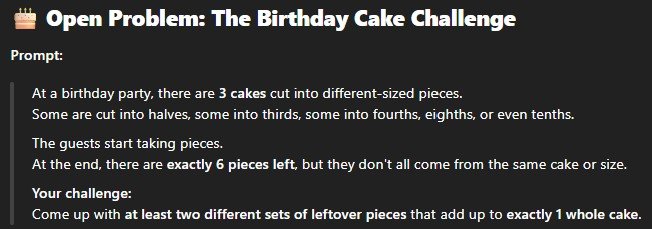
✅ Why it works: Open-ended question with multiple entry points – students can use simple fractions or challenge themselves with complex ones.
Prompt 2: Language Needs
Your Prompt: Reword this math instruction for a multilingual learner at WIDA Level 2: [insert instructions]
What ChatGPT Gives You: A reworded version for a multilingual learner at WIDA Level 2
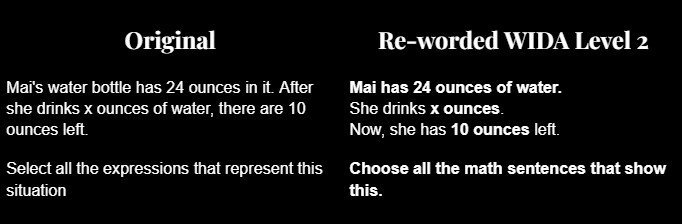
✅ Why it works: Shorter sentences, simpler vocabulary, clearer structure.
Prompt 3: Adapting Lessons for Student Interests
Your Prompt: “I’m teaching about graphing linear equations to 8th graders. Three students love sports. Create word problems that connect to this interest.”
What ChatGPT Gives You: Problems about basketball shot percentages, soccer scoring, etc. Same math skills, but tied to student interests.
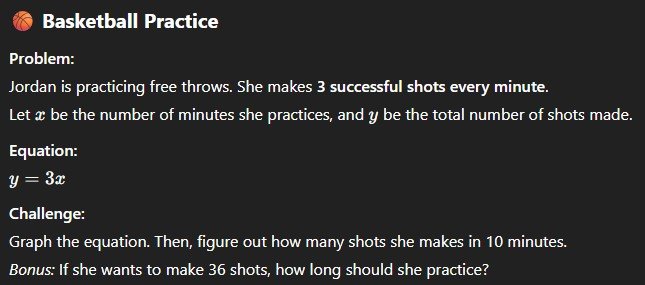
✅ Follow up: “Give me problems for students who love cooking” or “…who love social media.”
⚠️ Caution: ChatGPT can make up problems that don’t make sense. Always complete the problems before giving them to students.
Prompt FAIL: Graphic Organizer
Your Prompt: “I have this math problem: Create a graph showing the equations y=1/3x and y=1/3x-4. Explain how the graphs are the same and how they are different.
My students need more scaffolding to be successful. Create a graphic organizer.”
What ChatGPT Gives You: A basic organizer that removes too much thinking from the activity.
My follow-up attempts yielded similar results: ‘Give me a better graphic organizer that doesn’t remove the thinking…’ Even after trying again, it wasn’t usable.
At this point I gave up on ChatGPT for this specific prompt. Remember, ChatGPT is not a math teaching tool, so you’ll need to use your teacher judgment often. It is excellent at brainstorming so don’t throw it all away when you get a failed response! These mixed results highlight exactly why AI works best as a collaborative tool—you bring the teaching expertise to guide and refine what it generates.
Conclusion and Next Steps
Differentiation doesn’t have to be an all-or-nothing proposition anymore. You don’t have to choose between serving all your students well and maintaining your sanity.
Try it Out: Start this summer
- Pick one lesson you wanted to differentiate but didn’t have time
- Try one prompt above
- Note where it could help next year
AI enhances your expertise – it doesn’t replace it. You still bring the relationships, assessment, and deep math knowledge. ChatGPT just makes it faster.
Your students deserve differentiated instruction. You deserve time for your life. With AI, you can have both.
Ready to try more? Email me at karen@mathforhumans.ai for a free PDF: 19 AI Prompts for Math Differentiation.